Unit 2 - Introduction to Sensors, Actuator - Part 1
Introduction to Sensors and Transducers in IoT: Principles, Types, and Characteristics
The Internet of Things (IoT) bridges the physical and digital worlds. At the core of any IoT ecosystem is the ability to gather data from the physical environment and convert it into a format that computers can process. This foundational task is performed by sensors and transducers. Without these components, smart systems cannot perceive changes in temperature, pressure, light, or motion, making automation impossible.
Understanding Sensors and Transducers
In electronic instrumentation and IoT design, the terms "sensor" and "transducer" are frequently used interchangeably. However, from a technical standpoint, they have distinct functions within a data acquisition system.
Definition of a Transducer
A transducer is a physical device that converts one form of energy into another form. Most commonly in computer engineering, it converts a non-electrical physical quantity (such as mechanical displacement, thermal energy, or light intensity) into an electrical signal (such as voltage, current, or resistance), or vice versa.
Definition of a Sensor
A sensor is an element that detects a physical change or stimulus from the environment and produces a corresponding output. The output of a pure sensor might not always be directly usable by a microcontroller or digital processor without further conditioning.
In modern IoT hardware, a sensor often contains a transducer element inside it along with basic signal processing circuits to provide a readable, stable output.
Important Note: Every sensor contains a transduction principle, but not every transducer is used as a sensor. For example, an electric motor converts electrical energy into mechanical energy—it is a transducer, but it is not a sensor because its purpose is to create motion, not to measure it.
Conceptual Clarification
Hinglish Explanation: Transducer ka main kaam hota hai ek form ki energy ko doosri form mein convert karna (jaise heat ko voltage mein). Sensor ka kaam hota hai environment mein hone wale badlav ko detect karna. IoT mein hum jo sensors use karte hain, unke andar ek transducer pehle se laga hota hai jo physical change ko electrical signal mein badal deta hai taaki humara microcontroller use samajh sake.
Comparative Analysis: Sensor vs. Transducer
Parameter | Sensor | Transducer |
Core Function | Detects a physical quantity and gives a readable output. | Converts energy from one physical form to another. |
Component Structure | Consists of a sensing element and may include signal conditioning circuits. | Consists of a sensing element and a transduction element. |
Output Type | Usually an electrical signal or visual indication. | Can be electrical, mechanical, acoustic, or thermal. |
Example | Thermometer, LDR (Light Dependent Resistor), Proximity Sensor. | Piezoelectric crystal, Thermocouple, Photovoltaic cell. |
Basic Working Principles
Sensors operate based on various fundamental laws of physics. When a physical parameter changes, it alters the electrical properties of the sensor material. The most common working principles used in IoT devices include:
Resistive Principle: The electrical resistance of the material changes with physical changes. For example, in a thermistor, resistance changes with temperature.
Capacitive Principle: The distance between two conductive plates or the dielectric material between them changes due to external pressure or displacement, altering the overall capacitance.
Inductive Principle: Mechanical movement alters the magnetic flux linkage within a coil, changing its inductance. This is widely used in position tracking.
Piezoelectric Principle: Certain materials (like quartz crystals) generate an electric charge or voltage when mechanical stress or pressure is applied to them.
Photoelectric Principle: Light falling on a semiconductor material releases free electrons, changing its electrical conductivity or generating a voltage.
Hinglish Explanation: Jab kisi sensor par bahar se koi force, light, ya heat padti hai, toh uski internal properties (jaise resistance ya capacitance) badal jaati hain. Is badlav ki wajah se circuit mein voltage ya current change hota hai, jise humara Arduino ya Raspberry Pi microprocessor digital data ke roop mein read kar leta hai.
Classification of Sensors
To select the right sensor for an IoT application, it is essential to understand how they are classified. Sensors can be categorized based on power requirements, output signal type, measurement data, and operational placement.

1. Based on Power Requirement (Active vs. Passive)
Active Sensors: These sensors require an external power source to operate. They modify an externally applied signal to generate the measurement. Examples include Ultrasonic sensors, Infrared (IR) sensors, and Radar systems.
Passive Sensors: These sensors do not require any external power supply to detect a stimulus. They generate their own electrical signal directly from the physical energy change. Examples include Thermocouples and Piezoelectric sensors.
2. Based on Output Signal Type (Analog vs. Digital)
Analog Sensors: These sensors produce a continuous output voltage or current signal that is proportional to the physical quantity being measured. The signal has infinite values within a given range. Examples include the LM35 temperature sensor and LDRs.
Digital Sensors: These sensors convert the measured physical data into discrete digital values (0s and 1s) directly. They communicate with processors using digital protocols like $I^2C$, SPI, or UART. Examples include the DHT11 temperature and humidity sensor or digital accelerometers.
3. Based on the Dimension of Data (Scalar vs. Vector)
Scalar Sensors: These sensors measure only the magnitude of a physical quantity, independent of direction. Examples include temperature, humidity, and atmospheric pressure sensors.
Vector Sensors: These sensors measure both the magnitude and the specific direction of the physical quantity. Examples include Gyroscopes, Accelerometers, and Magnetometers.
Hinglish Explanation: Active sensors ko kaam karne ke liye alag se power supply chahiye hoti hai, jabki passive sensors bina kisi external power ke directly signal generate karte hain. Analog sensors ek continuous badalta hua voltage dete hain, jabki digital sensors data ko direct binary format (0 aur 1) mein bhejte hain, jisse error ke chances kam ho jaate hain.
Major Types of Sensors Used in IoT Applications
IoT networks rely on specific types of sensors deployed across fields like smart agriculture, industrial automation, and smart cities.
Temperature and Humidity Sensors
These devices track thermal conditions and moisture levels in the air. In agricultural IoT, they maintain greenhouse environments; in smart homes, they automate HVAC systems.
Common Components: DHT11, DHT22, LM35, BMP280.
Proximity and Position Sensors
Proximity sensors detect the presence or absence of an object within a specified range without physical contact. They are critical for robotics, automated parking systems, and conveyor belt monitoring.
Common Components: Ultrasonic sensors (HC-SR04), Infrared sensors, Inductive proximity switches.
Pressure Sensors
These sensors measure force per unit area exerted by gases or liquids. They are widely used in smart water management systems to detect pipe leaks and in automotive IoT to monitor tire pressure.
Common Components: Piezoelectric pressure sensors, Barometric sensors (BMP180).
Gas and Chemical Sensors
These modules detect specific gases, smoke, or pollution levels in the surrounding air. They ensure workplace safety in industries and track air quality index (AQI) in smart city nodes.
Common Components: MQ-2 (smoke/LPG), MQ-135 (air quality tracking).
Performance Characteristics and Specifications
To deploy a sensor successfully in a computer engineering or IoT project, you must analyze its performance metrics. These characteristics are divided into two categories: Static Characteristics and Dynamic Characteristics.
Static Characteristics
Static characteristics refer to the performance criteria of a sensor when the input physical quantity is either constant or changing very slowly over time.
Accuracy: The degree of closeness between the measured value shown by the sensor and the true, actual value of the physical quantity.
Precision: The ability of a sensor to give the exact same output value when the same input condition is measured multiple times consecutively under identical environmental conditions.
Sensitivity: The ratio of the change in the output electrical signal to the change in the input physical property. If a small change in temperature causes a large change in output voltage, the sensor has high sensitivity.
$$\text{Sensitivity} = \frac{\Delta \text{Output}}{\Delta \text{Input}}$$
Resolution: The smallest detectable change in the input physical signal that causes a measurable change in the sensor's output.
Linearity: The behavior of a sensor where the output changes in direct, straight-line proportion to the input across its entire operating range.
Range and Span: Range defines the minimum and maximum limits of the physical quantity that the sensor can measure safely (e.g., $-40^\circ\text{C}$ to $+125^\circ\text{C}$). Span is the algebraic difference between the maximum and minimum values ($\text{Span} = V_{\max} - V_{\min}$).
Hysteresis: The maximum difference in output readings obtained at the same input point when that point is approached from two different directions (first by increasing the input, and then by decreasing the input).
Drift: The gradual variation or shift in the sensor’s output reading over a prolonged period, even when the input physical quantity remains perfectly constant. This is often caused by aging components or environmental temperature changes.
Dynamic Characteristics
Dynamic characteristics describe the behavior of a sensor when the input physical quantity changes rapidly over time.
Speed of Response: The capability of a sensor to signal rapid or sudden changes in the input parameter without delay.
Response Time / Lag: The time delay between the application of an input stimulus change and the point where the sensor output reaches a specified percentage of its final correct value.
Fidelity: The ability of the sensor to reproduce the wave shape of the input signal accurately over time without introducing waveform distortion.
Dynamic Error: The difference between the true value of a rapidly changing physical parameter and the value indicated by the sensor, ignoring any static errors.
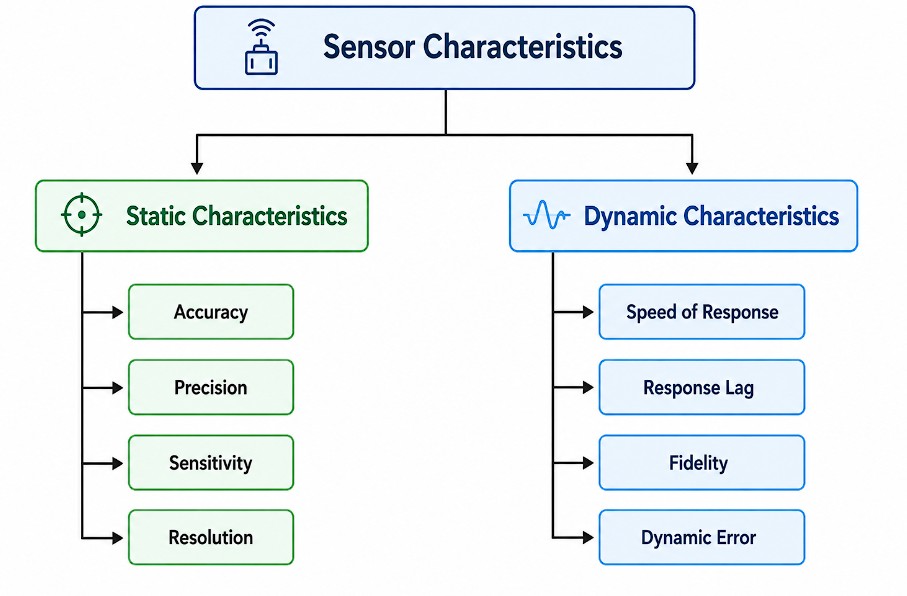
Hinglish Explanation: Accuracy ka matlab hai ki sensor ki value real value ke kitni paas hai. Precision ka matlab hai ki har baar measure karne par sensor same reading de raha hai ya nahi. Resolution woh sabse chota badlav hai jo sensor catch kar sakta hai. Jab input bahot tezi se badalta hai, tab hum Dynamic characteristics (jaise response time aur lag) ko check karte hain taaki data coordinate system delay-free kaam kare.
Applications of Sensors in IoT Networks
Sensors form the foundational layer (Perception Layer) of the standard IoT architecture. Some major industrial and commercial deployments include:
Smart Agriculture: Soil moisture sensors automate drip irrigation lines, while ambient light and humidity modules control greenhouse environments to maximize crop yield.
Industrial IoT (IIoT): Vibration and thermal sensors monitor factory machinery continuously. They detect early signs of mechanical wear, enabling predictive maintenance before a catastrophic failure occurs.
Healthcare Systems: Wearable biosensors keep track of patient vital parameters, such as heart rate, oxygen saturation ($SpO_2$), and body temperature, transmitting data directly to medical clouds.
Smart Cities: Acoustic sensors measure urban noise pollution levels, ultrasonic modules detect trash accumulation in smart waste bins, and gas sensors monitor ambient air pollution.
Advantages and Disadvantages of IoT Sensors
Advantages
Continuous Automation: Enables real-time, remote tracking of environments without human presence.
Enhanced Precision: Reduces human error in data logging, providing highly reliable data streams.
Miniaturization: Modern Micro-Electro-Mechanical Systems (MEMS) technology keeps sensors small, lightweight, and easy to embed on compact IoT circuit boards.
Low Power Consumption: Many modern digital sensors feature sleep modes that consume micro-amps ($\mu\text{A}$) of current, extending the battery life of remote edge devices.
Disadvantages
Environmental Degradation: Constant exposure to high humidity, extreme temperatures, or dust can degrade sensing materials over time, causing sensor drift.
Calibration Overhead: Sensors require periodic recalibration against standard references to maintain data accuracy.
Security Vulnerabilities: Raw data transmitted from insecure sensor nodes can be intercepted or spoofed by malicious actors in a network.
Summary and Key Takeaways
A transducer converts physical energy from one form to another, whereas a sensor detects changes in the environment and provides a measurable output.
Sensors are classified into Active/Passive based on external power dependency, and Analog/Digital based on the continuity of their output signal.
Key selection criteria depend on static characteristics like accuracy, sensitivity, linearity, and resolution, along with dynamic traits like response time and lag.
In IoT nodes, selecting the appropriate sensor requires balancing environmental constraints, electrical specifications, and communication protocols.
SEO Keywords
Internet of Things notes
Sensors and Transducers definition
Classification of sensors in IoT
Static and dynamic characteristics of sensors
Difference between sensor and transducer
Computer Engineering IoT notes
SPPU 2024 Pattern IoT Unit 2
Active and passive sensors explanation
IoT sensor specifications textbook
Engineering exam preparation IoT
Download PDF Notes & Get Updates
Join our WhatsApp channel for free PDF downloads and instant notifications when new notes drop.
Advertisement
Comments (0)
Sign in to join the discussion